
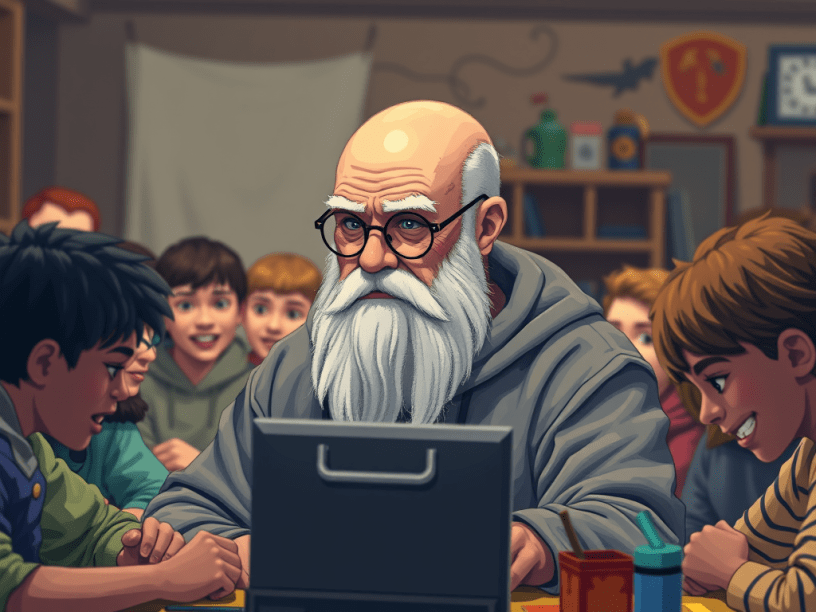
Today we’re talking about Game Mastering.
Yes, setting others up for success applies in other areas of one’s life, but in this case we’re referring to Game Masters. I’ve learned some difficult, nigh onto painful lessons over the years about this topic. I want to share what I mean by all this today in hopes I will save some other GM from a similar fate.
Failure to plan ahead a little bit can be the death knell of a long running campaign. It could even signal the end of a friendship while the group is breaking up. You don’t always have to go to Reddit for interpersonal drama. Sometimes it comes to you, the GM, in the form of your regular gaming group.
GM, please don’t be the one driving the plot wagon.
Those poor players. Some of them never saw it coming. Others did, but perhaps not in time. The plot wagon rolled into town right over the top of everyone. There were no survivors. Let me explain.
A lot of times we train/teach new GMs/Dungeon Masters how to run and set up adventures in a very linear fashion. The adventure goes A-to-B-to-C-to-D-to-E. The climax of the story usually occurs around C or D. Loot, if any, at about E. Experience, etc. afterward. There are variations on this formula, but it’s the easiest and most obvious things to teach most people because it looks like the structure of most books.
The problem comes in when some GM/DMs never move beyond it. Unfortunately, a lot of commercially written fantasy adventures are written this way. It’s like the GM has a novel to write and they just need the players to fill in the dialogue between scenes.
Then, just when the players think they have an original solution, the plot wagon pulls up and runs them flat. Basically, the GM decides that the players’ wackadoodle plan isn’t actually in the module, so they’re just going ahead with what is written in the module/book regardless.
Unfortunately this approach is often referred to as “railroading.” It leaves a lot of experience players feeling like maybe their choices don’t matter at a time when they 100% totally should. The game, at the end of the day, is all about the players. I get it. It’s hard to step back sometimes as a GM and just let it run..
A lot of online (YouTube) discourse lays the railroad tracks.
There are probably a good number of us old-timers who know what I’m talking about. I hear a good amount of talk, especially on YouTube, which usually tells new Dungeon Masters about creating plot, narrative, and story structure in their games. Hey, I’ll admit it. Back 30 years ago I was guilty of giving some of that same advice. I wouldn’t now, of course.
I’ll be brutal with this advice: If you want to create a story from start to finish and the players are expected to go along with every story beat, write a book. I know that might be hard to swallow for some D&D 5E or 5E.2024 Dungeon Masters. Sorry.
However, there is light at the end of the tunnel.
You don’t have to script every NPC dialog or figure out exactly where the group is headed next. Take some time during prep to build some NPCs, even if they’re generic, to drop into the characters’ lives whenever needed. That way you’re never caught completely off guard without a character for them to interact with.
I like to create minor NPCs with three notable traits, a description, and maybe a desired goal. No real stats unless I wholeheartedly believe they could potentially be involved in some sort of combat. Major NPCs get a description, important stats if needed, six traits, motivation, and a goal. I also put gear, spells, and a bit of personal history on them. They still take up less than a full page in most cases.
This technique can also be applied to locations the group could potentially visit. Inns, taverns, blacksmiths, bowyers/fletchers/arrow smiths, stable keepers, some random kid that hangs out around the practice area, stables, etc. In other words, people that the PCs could potentially encounter just walking down the main street of a village. I might also cook up something for a few random farmers, food vendors, townsfolk, town elders or other significant political figures, royalty (if any,) and maybe a shadowy individual who may or may not be attached to the thieves guild. Oh, and let’s not forget some military/law enforcement figures in the town. (For some reason that always seems to come up with the PCs…)
Next, not every NPC has to point the group in a specific direction.
Maybe the innkeeper really is clueless when it comes to the goings-on of the local townsfolk. Perhaps the blacksmith hasn’t ever heard of the magical MacGuffin the group is looking for. Maybe the farmer has never seen the giant ant monster that is reportedly terrorizing the other farmers. Not every character the group meets is a walking lore drop.
Sometimes the linear structure starts branching off. There are some dead ends. There are some false leads. There are some encounters or NPCs that aren’t even on the line. Some of my adventures started looking like a grid with a bunch of relationship notes and motivations. Unless it’s a dungeon with hallways that only connect certain rooms, of course.
The key here is to disconnect as a GM/DM.
Don’t pretend you know exactly what the group is going to do next. Yes, they might tell you at the end of the session, “We’re going to go to ______ (town) and talk to ______ (character.)”
Only to go a completely different route and talk to completely different character the next game. This is actually why I stopped keeping meticulous notes about plot and storyline. For one, I’m pretty sure my wife and one of my players who was a roommate were sneaking looks at my notes. For another, no plan ever survives contact with the PCs or the time table.
A lot of times I will have the name of the town, a few people who live there, and a vague idea of what they might run into. For everything else, there are random tables if I really get desperate. Otherwise, I try not to plan more than a session or two ahead. Maybe more if we’re doing a hexcrawl. (Long story for another time on that one. Yeesh.) Anything more than that and I’m probably wasting paper or pixels. The group usually manages to bypass, blow up, or overcomplicate anything specific I had plotted out, which is why I switched up my paradigm. (Which is pronounced, “pair-uh-dig-gum”)
But what about my BBEG and his plans for world domination?
If the group ignores whatever breadcrumbs and keeps offing his minions at every turn, maybe his plan goes ahead as scheduled because the group failed to interfere in time. Now the group has to wonder why the sky suddenly turned a shade of lime green and dragons are flying around everywhere like hummingbirds. Why wait for those meddling kids to interfere if they’re off starting a black smithy/bakery or hanging out with some random goblin they met at the inn? Don’t be afraid to lay down some consequences if they completely blow off that raid on the Death Star. Sometimes the villain gets their way and finishes their agenda. Now what will the group do?
Most of what I’m referring to so far is a sandbox style of play.
But there are some suggestions of other things that work. Sometimes it’s okay to have a plot in mind, but don’t get too attached. Most adventures still boil down to Who, What, Where, Why, possibly When and How. What matters to me as a GM is getting the ball rolling.
You can have the most elaborate sandbox campaign ever laid out on a hex map just waiting for the PCs to come spread some love, but it won’t do a lick of good unless they have some motivation to go explore. You can have the most sinister of BBEGs waiting for them with some crazy scheme to take over the Tri-Kingdom Area, but it does no good if the group never finds out about it and more importantly why they should get involved.
If the session or maybe the campaign starts in media res, the threat is imminent and the group must react in order to survive. Beware of overusing this tactic as players will begin to expect it. But once in a while it’s fun to leave them stranded on a mysterious island in the middle of nowhere with no idea how they got there.
Yes, PC backstories have a role to play in their motivation. Assuming they gave you anything to work with and it wasn’t a 39 page novel of their own, working some of what they gave you into the sandbox is usually pretty easy and will help later on in answering one of the big six questions above.
Other formats that might work for you.
My friend Kelsey Dionne talked about it in her monthly newsletter back in 2020. There can be a happy medium between sandboxing and railroading. I forget what she called it now, but it’s a format that starts out immersing the group in a story and then letting them decide if/where they want to run with it. Sometimes the group is fickle and they don’t. From what I know of Kelsey’s games, they usually do.
When I ran a lot of Cyberpunk, Werewolf, Deadlands, and superhero games, I usually didn’t have an elaborate plot in mind. The group had their home base and familiar NPCs that they saw daily. There was usually a villain out there, or several in some cases. All I needed was an inciting incident to get the ball rolling and maybe some sort of reward for going after the villain.
Having familiar NPCs that the group might be somewhat attached-to is pretty good motivation sometimes. The bank’s being robbed? Oh, Rex’s girlfriend was going to the bank this morning. Sure hope she’s not in the middle of a hostage situation… Of course we all know she will be. It’s not a railroad, but that one is hard for our heroes to turn down. Yes, they could let the boring old police handle it or they could hero up and go do something about it. (I used that “hero up” line once and nobody caught onto the reference until way later.)
You can build a corkboard or a marker board with names and relationships on it. If a business relationship between two NPCs falls apart, the group might be in for some financial tough times in a Cyberpunk game. If someone’s crush admits to it in the screamsheets right before the big concert, the following media scandal might make it hard to get out and do the real running. I’ve cooked up very elaborate relationship dynamics in the past. It’s fun, but the more NPCs you add, the more moving parts there are to keep track of from one week to the next. More on that in another article.
I’ve also done multi-branch linear style games where things might go A-D-C-H-Z with a lot of branches and dead ends going everywhere. Some points of the adventure didn’t even have a line drawn to them and were planned on the off chance the group pulled out something I hadn’t anticipated yet. Sometimes the outside world reacts to what the group is doing, other times NPCs have their own agendas to carry out, and the heroes may or may not interfere. Stop the train robbery or figure out why Farmer Barley’s cows are suffering from demonic possession. The stranger realization comes when the two are related.
I would also suggest taking a look at what novel writers are doing for more inspiration. Not everyone has a game modeled after a well-known actual play series. Not every GM is blessed with a dozen talented and well-paid voice actors in their cast, either. Sometimes novel writers will come up with interesting approaches that can be sandwiched into your game formatting.
I can talk about plotting and character development all day.
I used to deal with this kind of thing quite a bit. As I said originally, we teach new GM/DMs the linear formula because it’s the easiest to grasp and doesn’t require a ton of player motivation. Some people still prefer that style 20 years later.
However, some players don’t like to be told where to go and what to do. Setting them up for “success” is simply a matter of giving them NPCs, situations, and loot for them to interact with. They’ll find the adventure. It’s only a matter of when and how. Sometimes you have to just throw the module over your shoulder and ask the group, “Okay. What do you want to do now?”
As always, do what works best for you and your players. It’s fun to experiment with different presentation styles and adventure formats until you reach that sweet spot. Then just keep going. The group with thank you for keeping things interesting and engaging.
I say it every year, but I think 2026 bears repeating it. This year I intend to write more, read more, and discuss cool TTRPGs as well as supplements. Most of all, let’s just have more fun. Let’s explore. Let’s save the kingdom from the evil warlord. Let’s discuss all the fun stuff in gaming that we love.
With the world in the state it finds itself in today, please be kind. Please be considerate to one another even if we don’t agree. Lastly, please pursue the thing that brings you the most joy without harm to others. Thank you!


Comments are closed.