
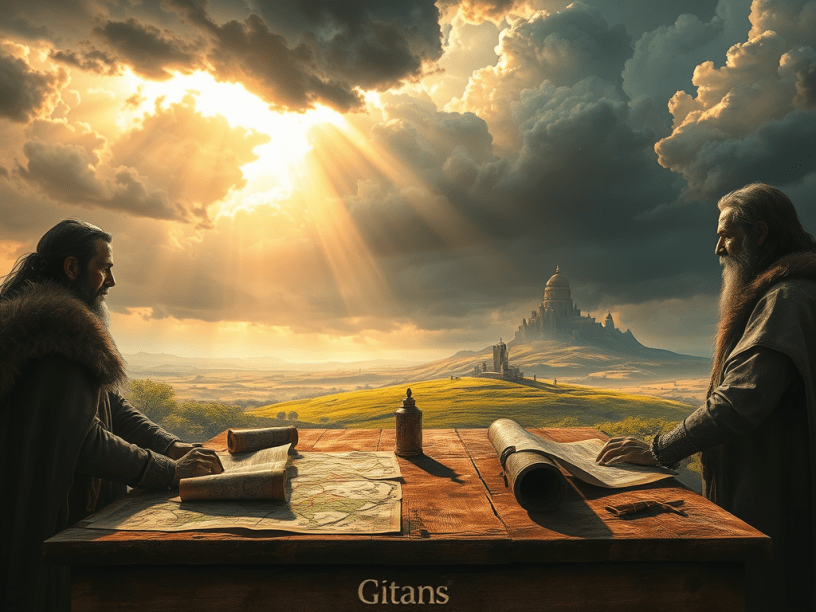
Disputes over land are never just about dirt and rocks. They’re about history, stories, power, and identity. Two or more groups say they own the same patch of ground, and suddenly every scrap of myth or memory becomes a weapon.
The Power of Paper
Some groups lean on written proof. Charters, decrees, treaties, pick your flavor. Someone always seems to find a dusty document at just the right moment. Maybe it’s real. Maybe it’s not. But once a map or a carved stone hits the table, it takes on a life of its own.
Otherwise some disputes can be settled by a higher authority such as nobility or the Church. That makes the dispute a little easier to resolve. Unless of course two different parties were granted the same land by two different authorities at the same time. People do love to argue.
Bloodlines and Burial Grounds
Others point to bloodlines. They’ll tell you their ancestors settled here first, or that their founding heroes were buried under these hills. Sometimes there’s a prophecy attached, a grand story about how their people were chosen to guard or rule this land. Truth doesn’t always matter as much as how loudly the story is told.
The real challenge comes when there is no written records and families, clans, etc passed down word-of-mouth stories about who owned what land for as far as the eye can see. It’s all fun and games until someone pulls out a shovel and starts trying to prove who is buried where. Graveyards and boundary stones sometimes get moved or destroyed by natural events or even agriculture. Messy, to say the least.
Sacred Ground, Sacred Struggle
Religion loves to get involved, too. Holy sites sit right in the middle of contested ground, and suddenly the gods themselves are on the battlefield. Priests and prophets insist that their faith was given this land as a sacred trust, and a single “miracle” can turn the tide of public opinion. I think we can all point to a good real world example of three religions all struggling over the same holy lands.
The Sweat and Soil Argument
And then there’s the practical claim, the sweat and soil argument. The folks who say, “We built the houses, cleared the fields, dug the wells. This is ours because we’re the ones who actually live here.” It’s not glamorous, but it’s a kind of proof that’s hard to argue with, unless you’ve got an army.
Some of these disputes can be taken to the local nobility, ruling council, or elders and a decision can be made on where to split a fair boundary. That is, of course, if both parties are amicable to that decision. Otherwise, people do love to squabble. One apple tree might be the cause of a full blown family wrestling match.
Might Makes Right
Which brings me to the ugliest claim of all: might makes right. Raise your banner, plant your fortresses, and declare it yours until someone stronger shows up. No myths, no paperwork, no prophecies. Just power.
This is where miniatures wargaming can meet up with roleplaying, just like it did in ye olden days of the 1970s. Both sides show up with their forces (both soldiers and possibly magic) and slug it out over the disputed territory until one side yields or can no longer continue to battle (probably because no one is left standing on that side.)
Caught in the Middle
And let’s not forget the people stuck in the middle. The villagers, farmers, and travelers who live on this contested land often don’t care about charters or bloodlines or divine decrees. They just want peace, and maybe a chance to feed their families without being told to swear allegiance to yet another lord.
The beauty of using rival claimants in your world is that you don’t need a single “correct” answer. Every proof is also propaganda. Every claim is a story with teeth. The real question is, who gets to decide which story becomes the truth: kings, priests, armies… or the people actually living on the land?
Thank you for being here with me today. I appreciate you. Keep it real, but please strive for positivity, too. Please embrace the things that bring you the most joy in your life.

 Jeff's Game Box