
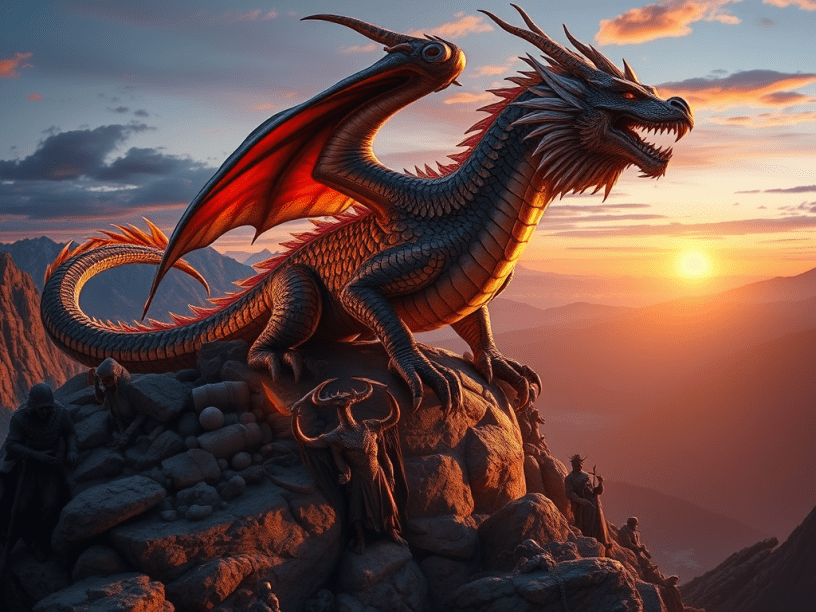
Part of Dragon Week here and on YouTube.

Dragons are highly evolved, very intelligent, meat eating killing machines that can fly and breathe fire (or something.) They live hundreds and maybe even a thousand years or more. Many accumulate wealth and magic over their lifetime as sort of a status symbol among their own kind. Regardless of whatever else you might think about dragons; they don’t live on for hundreds of years by engaging in trivial or potentially life threatening battles with little/no gain involved.
I think most dragons are shrewd thinkers and realize when they are outmatched. While a cornered dragon might be more dangerous than most animals, they do probably fight just as hard to survive. Otherwise, combats can be avoided, negotiations can be conducted, lairs can be abandoned and possibly conquered again later. What’s more, dragons have a very long memory and plan to live long enough to get revenge. Sometimes a long life accomplishes the desired outcome simply by being just that.
Dragon Week is a community shared creation effort among YouTubers and old bald white dudes from the Midwest flyover states. It was originally created by Ginny Di and Pointy Hat. Last year was Kraken Week. Not really my jam, but… This year is Dragon Week! Woot! Anyone can participate. Guidelines for getting involved here.
First, forget that whole myth of a missing scale being their weak spot.
Dragons are heavily armored, meat-eating, fire (or whatever) breathing killing machines. If they have a weak spot, it would be highly unlikely they would let anyone learn about it. Further they would make sure said missing scale was replaced by a false scale made out of solid metal until the old one grew back in. Yes, dragons can and do heal, at least in my game.
This myth of some adventurers invisibly sneaking into a heavily guarded lair full of traps and teeming with minions should be right out of the question. Even then, wouldn’t a super intelligent, centuries old dragon have contingencies and more than one escape route? Let’s not even get into all of the spells, scrying, and other magical safeguards a dragon and its intelligent minions would employ to keep it safe. The minions are in a symbiotic relationship with the dragon, so if it goes down they’re screwed too.
Oh, and that +3 Plate and +3 Vorpal Zweihander? They’re not just going to be lying around to be plundered. They’re going to be on the body and in the hands of the dragon’s most powerful and trustworthy lieutenant or assigned champion. Dragons can have bodyguards, too.
While we’re on the subject, let’s not forget the power of forging relationships as a dragon. Allies and minions make for awesome guards. I think dragon cults are going to be a popular thing in the Dragonbane world that I’m developing because a lot of beings tend to follow power and treasure. Some dragons probably favor undead or elementals as minions and lair guardians because they tend to live as long as the dragon will. Offspring are also great dragon lair guardians because they’re almost as powerful as the parent and they’re still learning.
Staying one step ahead of death for centuries and counting.
Sometimes the best defense is a good offense. Dragons tend to know when something enters their territory, the area immediately around their lair. On top of patrolling by air, their minions and other creatures can alert the dragon to the presence of unwanted guests.
Please, players, forget the myth of trapping a dragon in its lair. Yes, I’ve seen it done. I had a group once where the druid, played by my wife, cast Comet Fall on top of the windmill the dragon was hiding under and crushed the dragon. I’m still a bit bitter about that one. LOL! But normally, dragons are going to have an escape route or two planned in their lairs.
See, dragons don’t benefit from fighting every fight to the death. Unlike popular MMORPGs, boss fights with dragons don’t have to end with the dead dragon at the feet of the conquering party. Dragons are awesome when it comes to inflicting death on Player Characters, though.
Most dragons are going to want to take the fight to their natural element, usually in the air. Some dragons are aquatic or burrowers, but mostly they fly. When a dragon is in the air it becomes the fantasy equivalent of a helicopter gunship. It can rain its breath weapon, spells, and flyby attacks on the group. It never has to move within melee range if it chooses not to. Regular arrows are usually of little consequence to an airborne dragon.
To quote a famous dragon, “Death from above.”
If a dragon comes to ground from out of the air, it’s usually to pounce on a member of the party and squash them into a fine goo. Those claws and teeth aren’t just for show. I normally compare dragons to large cats. (My Dragonbane dragons are actually based on various large cats.) Dragons can literally fall out of the sky and rake with their back claws while an opponent is pinned.
A dragon in the air can be the scariest encounter in the game. At least giants have to have their feet on the ground. Dragons can just fly off if they don’t like how things are going. They can also do hit-and-run tactics from the air. The best thing a party can do against an angry dragon in the air is run for cover and hide. There are just times to avoid combat with a dragon.
Bonus tip: Duplicity.
I tend to run dragons with the innate ability to shapeshift into a bipedal humanoid of their choice in almost any game, even if I have to homebrew it in. As super intelligent apex predators, dragons have the advantage to lure unsuspecting adventurers to their horrible doom. Alternately, if all it takes to get the party of its case, the dragon could offer up some magic trinkets or gold and buy the party off. One encounter could set up a dragon as the new nemesis to the group.
Dragons in many games are not constrained by any sort of moral alignment system. Maybe the dragon is kind, good natured, and friendly. The next dragon down the road might seem friendly but will turn on the party the second their backs are turned. Suddenly the group could be in a lot of trouble. Maybe they didn’t know the dragon was a dragon.
Dragons have the advantage of longevity. They can always come back to haunt the group further down the road. Remember that magic trinket the dragon gave to some member of the party? Maybe the dragon is using it to track that character’s movements. A little scrying and suddenly the dragon is showing up on the group’s doorstep when they least expect it.
Dragons can lurk and wait to strike when the group is down. Admittedly, the GM who does this is kinda mean, but the dragon as a character would do it. It makes sense to hit the party on the way out of the dungeon to rest and recuperate. Ruthless? Yes. But hitting the group when they’re down on HP, arrows, spells, potions, etc. It’s a testament to the dragon’s minions if the group is beat up enough for this to work.

 Jeff's Game Box