
One of the biggest traps I see in worldbuilding is writing too much.

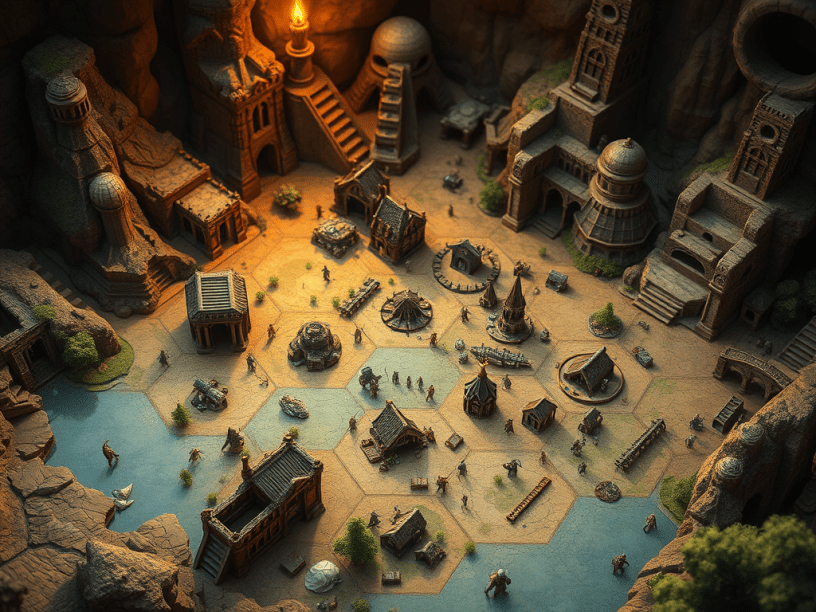
I started a new hex block on the 20th. I’m using Atelier Clandestin’s Sandbox Generator. Here’s my Affiliate Link to it on DriveThruRPG.com if you’re interested. The map is designed by creating a starter hex and two concentric rings around it. Then the blocks of 5×5 hexes jigsaw together to form the larger map. There are other ways to continue the map of course, but so far this is working.
I think the biggest challenge aside from keeping up on Hex-A-Day 2025 is not to go bonkers and design all of the world from continents, climates, biomes, religion, nations, and so on. (Here’s that link to the Hex-A-Day 2025 workbook, btw.) Yes, there are entire books full of random tables to generate those things and I will get to them eventually. But I want everything to fit my world and the themes I’m going for specifically.
My fantasy TableTop RolePlaying Game worldbuilding strategy has sort of evolved through years of experimentation. I’m opting for something a little more organic and exploration based this time. There’s no big overarching plot this first time around. My hexes are somewhat random and the solo group I’m using can meander into different locations to explore. There are no nations, established religion, etc yet.
Just because something isn’t listed in the hex doesn’t mean it can’t be. Eventually there might be entire nations that emerge. So far the dice have given me small settlements, for which I am grateful, and a ton of dungeons, ruins, and indications of prior civilizations. That’s exactly what I was hoping for!
Please do what works best for you as a Game Master and your group. What works for me at my table may not work for yours and vice versa. The main focus is to have fun. There is no right or wrong way to roleplay.
A side note about my personal philosophy.
There’s been a lot of uproar in the TTRPG community for the last few years about gaming companies inserting their personal or political biases into our games, especially fantasy games. I think this can be done well without flogging people over the head with it. Personally, I’m not a fan of dogmatic, oppressive, ritualistic religions. (It’s just better if I don’t set foot in churches, temples, etc because I might take issue with the person in charge of the place. We just have to agree to disagree.)
That’s why there won’t be a lot of mention of any organized religions in the world I’m building. It’s no coincidence that Dragonbane takes a similar approach in its game design. It’s why I totally love that game so much over Pathfinder 2e, Dungeons & Dragons, etc. While the in game religions in most fantasy TTRPGs don’t reflect on anything in the real world, a lot of the game designers’ other values do.
If/when I publish the world I’m working on, the only thing resembling religion will probably be the various demon, zombie, or evil Archmage cults that have sprung up as a result of events from the prior civilizations. I might even sneak in a few lines about how one of the ancient civilizations was ruined by organized religion. Who knows?
Something E Gary Gygax, creator of Dungeons & Dragons talked about back in the day has always stuck with me (and of course I can’t find the direct quote now.) He said something about not using real world religions in D&D because the game is a work of fiction. As a GM and game designer, that has always been one of my personal guiding principles.
Spirituality, “paganism”, and some of my personal real life conspiracy theories are all open game, however. The spirit world in the game world I’m presently working on his huge and will eventually become a key feature. Animists, Druids, Shamans will all become valuable professions with more spells, secondary skills, etc.
Also, reptilians, Men in Black, and my beloved Grays will all make an appearance at some point. Laser guns, electronic devices, etc? No. We’re keeping this a fantasy game for all intents and purposes. We will go back to why the old world lies in ruins and was completely overgrown or buried prior to the current one.
Did I mention keeping it simple?
Apologies for the sidetrack. So far my hexes are consisting of three things I roll for and then if I feel the hex needs something more I roll another element or just pick something that sounds appropriate. The beauty of a hexcrawl is that the PCs can only move so far in one or two shifts while running into things and trying to survive. I’m doing my best not to overpopulate the various hexes partly for the sake of time and partly for ease of reference.
I admire people that write out all the overarching plot, nations, etc. My only concern about doing that has always been whether the PCs will ever interact with any of it or will they go completely off the map and do something else? This is also why I haven’t mapped every dungeon, village, ruins, etc so far. If it becomes relevant in game, I’ll draw it out.

To begin with, all we ever really need is a settlement, a dungeon, and some surrounding environment to explore. I’m more concerned with filling in the details of where the group is headed next. The average group doesn’t have a horse or heaven forbid any way to fly or teleport. Foot travel through treacherous terrain, surrounded by monsters on all sides, and being chased by someone they’ve cheesed off in another hex. Diplomacy is its own reward especially in a vast, unforgiving wilderness.
Contrary to campaign settings of Dungeons & Dragons or even Dragonbane past, I don’t feel compelled to bake in some vast overwhelming, world-shaking plot at this stage. I hear a great deal about sandbox style play and hexcrawling fits very well with that narrative style. Each day is a new adventure and each hex contains its own challenges and rewards.
I have given a lot of thought to setting a countdown timer once the hexcrawl begins by taking 1d8 and increasing it by one each time the group moves into a new hex. At the same time I’m going to roll another d8. If the roll is equal to or less than the timer die, something bigger happens. Maybe the group runs into a dragon or a demon. Maybe they cross paths with an army from a nearby city-state. I’ll undoubtedly have a 1d12 table of major events. It could just be a major weather event. Or a kaiju. (grin.)
More to come next week.
We will be taking a deeper look into someone else’s world a bit over the next week or so. I’ve been asked to take a deeper look at the World of Myrr by Cawood Publishing. I believe in that book so much I backed the Kickstarter for it.

Two things had me convinced this was going to be a success right out of the gate. I have collected all but two of the Cawood monster books for D&D 5E and I love them. I also admire the creativity and the art style in the monster books and again from the World of Myrr, making it an easy call. I was impressed as usual when it arrived. The other nice thing about it is that it’s systemless enough that I can overwrite Dragonbane onto it without a lot of trouble with ease. (Wink.) Myrr has been an underlying inspiration for a lot of my worldbuilding efforts.
I’ll leave it here for now before I jump back up on my soapbox and start ranting again. (LOL?) I’m also still working on today’s YouTube video. Maybe I’ll even be able to jump on camera without too many interruptions. Yes, I know the experts recommend filming 12 videos at a time, but that would require me to prep 12 outlines all at once. Which I haven’t had the time to do just yet. We’ll get there. Hopefully I won’t fall down any more rabbit holes.
Thank you for being here with me today. I appreciate you. Keep it real, but please strive for positivity, too. Please embrace the things that bring you the most joy in your life.

 Jeff's Game Box