

Always ask before you roll, “Do the dice need to be involved?”

You have a pristine character sheet with a lot of shiny skills and abilities that allow us to do all kinds of interesting things. But do we need to roll for everything? One of the biggest challenges faced by new Player and Game Masters regardless of your game of choice is when to roll the dice and for what.
I’m a dice loving math rock goblin, so any time I get to play with my clickety clack shinies is good. However, we have to often temper that with what is going to be best for the game. Does the die roll forward the story or help the characters in some way? I recently saw a rather brilliant video about this topic by our friend at Shop of the Borderlands on YouTube. You can watch it here.
Disclaimer: Statements expressed in this article are strictly my opinion. If you disagree or have a different opinion, that’s okay. I’m not an expert on everything. I’m not always right. I’m just writing from my experience as I know it. Your mileage may vary.
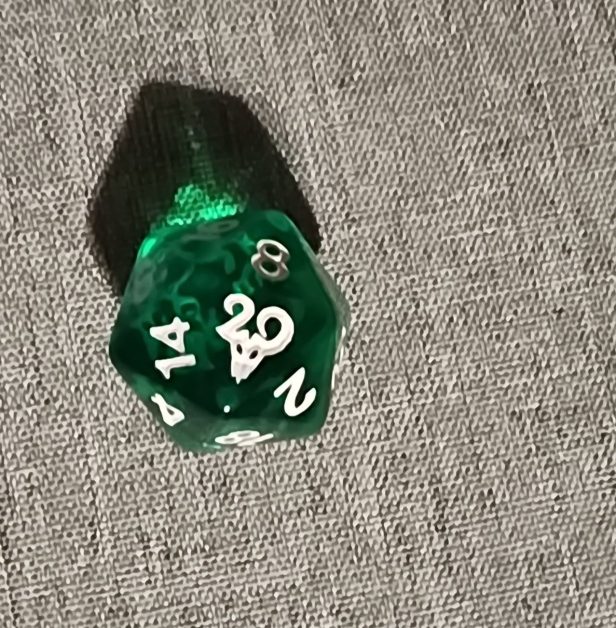
“Oops. Rolled a Demon.”
In Dragonbane RPG, a critical failure is called a Demon. In Ampersand game terms, it’s like rolling a Natural One. In Dragonbane, Natural Twenty rolls are actually a very bad thing because it’s what we call a “Roll Under” system. Pathfinder, Shadowdark, and Dungeon Crawl Classics are all “Roll Over” or “Roll High” games by comparison. (If you’re looking to check Dragonbane out, and I can’t recommend it enough, here’s my affiliate link to the FREE Quickstart Rules on DriveThruRPG.com
As suggested by the video above, the entire session, story, adventure, etc should not hinge on a die roll. I agree with this entirely. If one botched Perception (Or Spot Hidden in DB,) roll by one character is going to throw everything into a tailspin, don’t do it. If the Players are asking crucial questions to the NPCs, each other, exploring the scene or area, then the exposition from their actions should probably not require a roll at all.
Die rolls inject a degree of uncertainty or sometimes surety into a situation that we wouldn’t necessarily have in a deeply immersed world. Sherlock Holmes didn’t become the World’s Greatest Detective (or second greatest next to that guy in the Bat Costume) by making a skill check to know if his hunches were all correct. Mr. Holmes had the uncanny knack for reading people, situations, and clues while forming a solid conclusion. In game terms that might translate to a series of Perception, Insight, Investigation, and Knowledge rolls, but there was also good old gut instinct involved.
The point of the video and the point I’d like to make is: don’t let one bad die roll derail the whole game. It means that if the information being sought after is critical enough, let the group figure it out or find it rather than just one die roll for it.
Perception (Awareness) is in the eyes of the character.
Back in ye olden editions of D&D we used Perception a great deal. Then someone got smart and figured out what is now called “Passive Perception.” It came about because sometimes calling for the check gave away the fact that there was something in the room worth checking out. Suddenly everyone was wanting to roll.

*Please note there are no SCPs in this pic.
Dragonbane fixes the everybody rolls problem right in the main rules. ONE roll. That’s it. If the character fails, they may push, but that’s it. And there are no funky dice modifiers in Dragonbane. We’ll talk about pushing the roll in another article. It allows a reroll, but at a pretty steep cost. Oh, and the whole group still doesn’t jump in. ONE character may assist if they are physically close and have reason to work together. (I personally think Dragonbane has a better all-around skill system than a lot of other RPGs.)
I also think there are times it’s just fair to ask questions either to the GM or other characters. Maybe the GM missed describing something. Maybe something new is overturned that changes up the situation. It’s not always a giveaway of prizes when someone enters the room and makes a Spot Hidden check.
Despair not, ye fellow lovers of dice!
There are still many opportunities to roll them bones as they say. Combat is the big obvious one. We’re going to roll dice for hits, damage, and all that fun stuff. Character generation is sometimes a lot of dice rolling depending on the system. Skills and abilities is where they start to become a sticky wicket.

Five adventurers enter a room. GMs, please do not make the first thing you say is “Roll a Perception (Spot Hidden) Check.” Old men will groan, and you’ll almost inevitably get one success. Instead, let them tell you how they explore the room. Maybe they neglect to look over their surroundings. You can describe what they see, hear, smell, and touch without ever asking for a dice check. Now, if a player starts looking for tripwires, tapping floor tiles, pulling books off the shelf, etc; it might be appropriate to ask that one player for a Perception (Awareness) Check.
I think it’s perfectly acceptable for Skill rolls help the characters move the story forward or assist in the investigation. Back to the Sherlock Holmes example, when he meets someone for the first time, he would probably look them over from head to toe rapidly to see what he can surmise about that person in case it comes up later. The GM might call for a Perception (Spot Hidden) roll at that point and tell Sherlock’s player that the guy has a small nick on his face, probably from a dull razor, a tiny spot of mustard on his collar, the yellow kind they serve at the sausage stand down the way, and mud on the worn down heel of the man’s left shoe, likely the same as the impressions on the ground at the graveyard. (Because it sounds very Holmesian.) Oh, and Sherlock’s player will probably ask if the man’s cane looks heavy enough to have a sword in it since the victim was clearly run through with a fine blade.
The point is Sherlock’s rolls push his investigations forward as opposed to: “Roll an Investigation Check.” Oh 17? That succeeds (d20 Roll High.) Okay, it’s probably this guy that walked in the door just now because he’s got a sword cane and likes to walk around in the graveyard. (*Loose example.) Basically, GMs- don’t give the players the whole kit and kaboodle on one roll if the scene can be role-played out based on the results of one or two checks.

“Well ackshually…”
“What’s Investigate for if I can’t use it on a crime scene, Jeff?”
I’m glad you asked. Suppose Holmes sends Watson to City Hall to find out what he can about the building on the corner that is supposedly haunted by the ghost of the Widow Weasley. Watson’s player might roleplay through getting into the records room by Persuasion rolls and clever dialogue, but once he’s in the records room, the real search begins. Watson’s player might say “I’m looking for records on the old Weasley place.”
The GM could ask Watson’s player to roll Investigation for finding records that lead to more clues, more records, or maybe even if something amiss in those records. A chance of success or failure won’t completely cascade into ruin, but success will benefit the group with a few clues they might not have any other way. It gives Watson’s player a running start at cracking the case.
GMs have a lot on their plate on any given day during any given session. It’s okay. You don’t have to be perfect. Sometimes it might be faster or more expedient to call for a skill roll to skip several minutes worth of exposition in a session where time is limited. That’s just practical as long as it doesn’t deprive the player of their entire turn or time in the spotlight. It’s up to the GM.
Yup, time for me to say it-
What works for my game sessions in my campaigns or at a convention might not work for yours. Some GMs prefer to drop group Perception (Spot Hidden) rolls at the beginning of a turn when the characters enter a room. That’s okay. It’s just not how I prefer to run my game.
I like to do long, fairly involved travel sequences as a lot of fantasy games feature terrain hazards and encounters I want to play up. Long travel also gives the characters time to talk amongst themselves and learn about one another more. Some groups like to skip the whole experience, and that’s okay too. I have my preferences. In Dragonbane, some GMs just have someone make a Bushcraft roll to set up camp and feed everyone. Their game, their preference. That’s cool.
You can’t get it wrong. No one is going to come confiscate all of your books and dice for running skill and attribute checks the way you and your group prefer to do it. D&D, Dragonbane, and other fantasy games are subjective in nature. RPGs are like art appreciation. No two people are going to see it the same way.
To sum things up, GMs, try to cut the players a little slack when it comes to dice rolling. Sometimes it’s better not to call for a roll if things can easily be resolved in the natural course of character knowledge or by some clever roleplaying. Players- please don’t beg for skill rolls. Describe what the character is doing or saying and let the GM decide.
Thank you for being here today with me. I appreciate you. Please embrace the things that bring you the most joy.

 Jeff's Game Box
Comments are closed.