

We all know the old 3×3 Alignment grid is on its way out of most games, but…
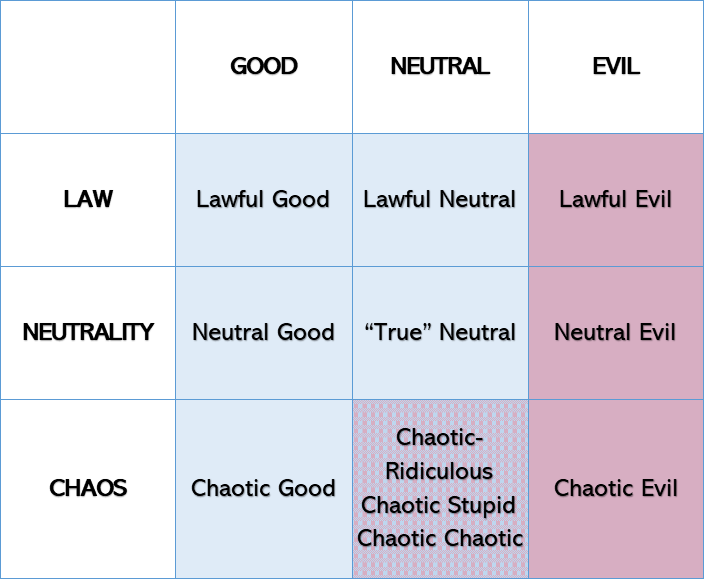
One thing that old, long-standing, loosely though-out, moral/ethical Tic Tac Toe board did was keep the party on track with one another. What do I mean? In old parlance, The Neutral characters were the glue that held the group together while the Lawful Good, Chaotic Good, Neutral Good, Lawful Neutral and Chaotic Ridiculous characters all found a way to relate to one another. In my groups, we held fast to the “No Evil Characters” rule.
Alignments didn’t necessarily force party cohesion, in fact it probably caused just as many arguments as it prevented. However, sitting down before the campaign started and saying, “No evil characters and Chaotic Neutral is held in low regard” really helped form a group that could at least work toward a common goal.
Session Zero and player communication has replaced the need for Alignment.
We know alignment was an artificial construct from the old days of Dungeons & Dragons and conceptually dates back to miniatures wargaming. The idea goes back to army or monster morale and motivations on the battlefield. Certain troops would break if not aligned with their unit commander or wouldn’t ally with certain armies.
Nowadays, we have Session Zero or something along those lines that the start of the campaign. A lot of groups have gone with the tradition of rolling characters as a group. (Not everyone has a massive binder full of characters waiting to get thrown into a game. I mean, depending on the game…) Creating characters together hopefully leads to the creation of reasons to get together and hang around as a group before the adventure even starts.
Character backgrounds and personalities speak volumes beyond alignments.
I delight in playing characters with somewhat sketchy ethics. Even my NPCs in some fantasy games have a heart of gold and pockets full of someone else’s fine silverware. Sometimes the druid of the group makes the most logical, well considered choices because he’s free of the emotional baggage holding everyone else at bay. Most of my truly goody-two-shoes characters usually have a skeleton or two in their closet.
The Alignment system made for a good writing tool, and I still loosely apply it to NPCs on the fly or when I’m writing fiction. It’s a quick indicator of what the character’s ethics and morals will be in most regular situations. There can always be exceptions.
I know some players run for cover at the mere notion of creating a background for their character. It’s built into a lot of fantasy games. Otherwise, there are volumes of books written about good roleplaying techniques and how to properly prepare a more dramatic character. I also tell players if they don’t want to give me a couple of paragraphs of backstory, I’ll help them create one and type it out for them. (*Sometimes we have my two youngest kids or a new player that has some learning disabilities.)
I will tell players we can fill in a backstory if need be, but can we at least get six words to describe the characters personality or attitude. Any six coherent adjectives are all I ever need as a player for any given character I make. I use three personality traits or six for NPCs when I’m a GM in lieu of writing out longer descriptions. One example for my rogue character would be: Comedic, Kleptomaniac, Kind-Hearted, Loveable, Free-wheeling, and scheming. I think we all have characters we can describe from books, TV, movies, etc this way.
What happens with lone wolf type characters?
Sometimes as GMs we seem to get that one player who just has to play their own rendition of Batman or Solomon Kane in a fantasy game. It’s the mysterious lurker in the shadows who does whatever they please and answers to no one. Remember what I said about Chaotic Neutral characters earlier and how we discourage them? Players that want to be all edgy and not work with the group for the most part are asked to refine their characters or make a new one entirely. In the most extreme cases, players that can’t make a character that at least fits in with the party a little bit are asked to find a group that is more in line with their play style. (*I hate giving that speech as a GM. It makes me want to do Solo plays in a corner with just my dice and books.)
Sometimes I’ll make an NPC that pops in and out of the group for a fantasy game if someone can’t make it to the session. I think having slightly more chaotic or sporadic NPCs are a lot easier than having a player who behaves that way. It’s not an attempt to railroad the group as much as it is to fill in vital gaps when the NPCs are a bit flakey.
The other thing I always strive to prevent are negative player interactions. I go out of my way to prevent player vs player (PvP) conflicts at all costs. I think it can lead to bad blood withing the group outside of the game or out of character and tends to ruin the fun for a lot of us. I also don’t care for the idea of the GM planting a turncoat within the party for much the same reason. We want to have fun, and I’m always clear about that at the start of the game.
More on this in days to come. I used to talk about Alignment a lot back in the day. There are so many nuances to this old school system that could be covered in depth.
Thank you for stopping by. I appreciate you. Please embrace that which brings you the most joy today.

 Jeff's Game Box