

I wish to be straightforward about this.
I think Wizards of the Coast is going a little overboard with the changes to the language used in Dungeons & Dragons 5E. If these changes are what we are in for with the 2024 edition, I can’t honestly say I’m going to be interested in buying anything from them until the next new/not-new edition.
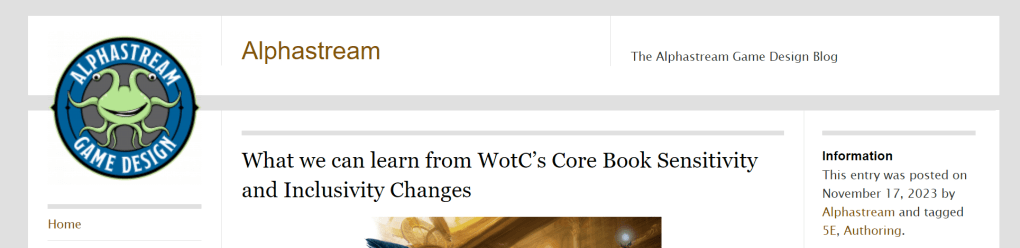
A little backstory here: This nice blog (Alphastream’s Link) as well as a Alphastream’s YouTube channel: broke the story about changes Wizards of the Coast made in the 2014 Dungeons & Dragons core rulebooks. These changes were prompted by WotC’s #Hadozee public relations nightmare on social media. WotC has been reticent about these changes, even since the mighty WotC Content Creators’ Summit.
I will say I think Alphastream has done a fine job of covering this topic. I highly recommend checking out their video and blog ab out the matter before going on YouTube or elsewhere to scream about WotC yet again. While I do have a bit of concern about what WotC is doing, it has absolutely nothing to do with Alphastream’s coverage of the matter. I appreciate their efforts in bringing this matter forward.
Disclaimer: Statements expressed in this article are strictly my opinion. If you disagree or have a different opinion, that’s okay. I’m not an expert on everything. I’m not always right. I’m just writing from my experience as I know it. Your mileage may vary.
I don’t agree with what WotC is doing from a Sociological/Anthropological perspective.

Here’s a quick rundown on how language works- We have a simple concept with no descriptors such as a rock; the simple kind commonly found lying on the ground. In order to convey this concept to our fellow human beings, we have a sound associated with said concept in our common language of English, “UR-awk.” We have a set of squiggles in our common language (English in this case,) R-O-C-K.
When we use language there is implied consent to use these rounds and these squiggles to mean they stand for this concept. If I simply say, “It’s a rock,” most people who speak English can form some idea of what I’m talking about. No one will know what kind of specific rock, big or small, composition of stone, position of said rock on Earth or in space, etc without some descriptors.
Descriptors are another set of concepts that help further define our base concept. I say the rock is “black, about the size of my fist, round, over there on the ground (pointing.)” We have to make certain assumptions about our common language. Obviously the listener/reader must be able to physically understand what I’m saying or it’s a different spoken/written language entirely (ASLAN or Braille for examples.) That’s not ableist, it’s just forming a common reference in terms of language.
Descriptors help us define concepts which then build upon other concepts. If I say that rock over there is a black cobble, it’s a lot different than describing the stone slabs used to build the Great Pyramid in Egypt or Stonehenge in England. If we as humans can’t agree on a common language and everyone goes around making up new language for concepts on their own, we’re lost as a society and as a culture wherever we are.
English is a complicated bugger when it comes to our descriptive terms. I’m around this language all day, every day as a native speaker. We have a ridiculous number of different ways to describe the same things in English. Some is subtle nuance; other words subjectively change the meaning entirely depending on context.
“Enormous Space rock” could be the Martian moon Phobos, or a global mass extinction event headed for Earth. It all just depends on context and description. What’s enormous? What’s enormous in my eyes may not be the same thing the person sitting next to me pictures unless we’re both looking at the same picture. Maybe they think it’s “gigantic,” or maybe they just say, “It’s big.”
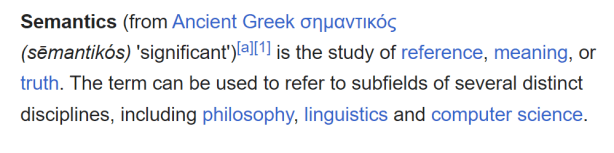
This is where we start getting into semantics. Now, semantics is complicated enough to study in and of itself without breaking it down farther. Needless to say it is vital to culture and basic human understanding that we come to common ground on our definitions through language.
Moving right on through the rest of the Linguistics lesson into gaming…

Our words have meaning. This is true in academia, business, and yes, even in TTRPGs. Words matter more so in TTRPGs, because that’s how we play these games. If we can’t agree on common terms, we’re screwed. It’s pointless to continue.
I can already hear the angry clacking of keyboard warriors preparing to fry me on social media for this one. For the record, I’m no rogue scholar. My wife regularly kicks my butt at Scrabble. Oh, my voting record is moderate to liberal, but I vote based on the candidate who can best address the issues I find are relevant. (If you think it’s hard to find an honest politician in the USA, try finding one interested in actual issues beyond what their opponent said.) I digress.
We all have our little hangups when it comes to TTRPGs just like we have them when it comes to reading blog articles or fiction. Maybe my writing style- complete with punctuation, grammar, and editing “errors-” doesn’t agree with everyone. (I used to give college English professors fits.) By no means am I trying to claim any degree of superiority, only preference. At the end of the day, all any of us can claim are our preferences, opinions, and discernment.
How does this mesh up with WotC’s latest malarky?

Which is kinda funny because it’s not even the “latest” malarky. They’ve been sliding these little changes under our noses on the digital side of things for months already. Alphastream bringing it up on November 17 has caused furor among the TTRPG Grognards for better or worse.
I debated heavily about writing out my take on the whole thing given my slightly different stance on the matter. Any language change that impacts gameplay either mechanically or dramatically is a cause for me to be concerned about it. We simple must be able to understand one another or roleplaying is lost.
I already don’t agree with some of the language changes that are being presented by Wizards of the Coast. It’s not that I’m a hardcore, right-wing, psycho, fascist, lunatic just trying to make a political point. (If I ever get anywhere near that bad, I hope someone deletes me or changes my meds.) I feel that some of the language changes neuter the intended meaning of the concepts presented. Other game companies are (foolishly) following suit with similar changes of their own. I hesitate to throw out examples of this because I don’t want to seem ableist, racist, -phobic or whatever people on X (Twitter) decide I’m guilty of this time.
Let’s talk about a few specific examples from the WotC text changes.

“Blinded” is not an ableist poke at people who are permanently unsighted. Blinded as a game condition means something has happened to make it so the character (NOT the player) can’t see. Have you ever had the misfortune of being in the same room as a flashbang grenade or next to a firework at close range? You aren’t “unaware-d,” you are blinded and possibly deafened as well. Unaware makes it sound casual and/or chosen like someone just didn’t know what was going on. Blindness is a serious matter.
I can be looking right at something and be unaware of what’s going on with it. (Happens all the time on here.) Awareness is more esoteric and broader than if I just plain physically can’t see sh🦆t. It’s not all that dissimilar to the difference between “awake” and “woke.”
Civilization defines the state of an environment, not a poke at other cultures that aren’t in a similar state of development. When I say “civilization,” I mean paved roads, running water, indoor toilets, electricity, and other creature comforts different from sleeping on the bare ground, no fire or roof over my head. It’s not a jab at another culture for not behaving the same way mine does. (Have you seen how some Caucasian males act in urban Iowa? Yeesh.)
At some point in a game and in real life, we absolutely have to agree on which terms go with which definitions. As a wise man once said, “You can’t please all of the people all of the time.” I think Wizards of the Coast is trying way too hard to make everyone happy to the point of most of their audience being unhappy.
The next edition/revision/whatever of D&D might be pushing people out of the hobby.
Personally, I’m ready to go back to Old School gaming and stay there for a good long while. Clearly WotC isn’t interested in me as a customer. Their loss given how much I’ve spent on their products over the years. I’ll continue running Third Party Publisher 5E content and stealing bits of the Monster Manuals here and there. Otherwise, I’m telling everyone to vote with your dollars.
I hope I’m wrong. Maybe WotC won’t mangle the language in the new PHB and Monster Manual so bad we won’t be able to tell what they’re going on about. I have enough issues with WotC’s lack of editing already, this isn’t helping. I can make a case for getting rid of certain writers and editors without this little nothingburger riding along.
As with every TTRPG discussion, I urge everyone to use their own discernment. Do what you think is best for you and your group. Support whomever you want to regardless of what people on the Internet might say. Maybe we’re all using barbaric, antiquated, offensive language out here in the world I live in.
Just because WotC changes their language, doesn’t mean we have to.

I almost hate to publish this one in some ways because of the utter lack of relevance in the TTRPG culture. Yes, D&D is the biggest brand in TTRPGs, most recognized, etc. Good for them. We don’t have to do everything we do just because they do it. That’s their style guide, not mine.
I’ll say it again: No one is coming for your D&D books just because you’re not playing it the way WotC says is most culturally correct. Free speech comes with its own unique set of drawbacks. Anyone can use the language any way they want so long as it doesn’t convey an immediate threat to the safety of others. (No yelling “Fire!” in a crowded TTRPG convention hall.)
You can run the most awful, bigoted, phobic game of D&D ever and people have the right to walk away from that for not feeling safe. You can use TTRPG Safety Tools or not and people can walk away because they don’t feel safe. The TTRPG book police aren’t going to shut down your game no matter what you do. We’re left to police ourselves because we have free speech.
It’s true we don’t use certain words on the Internet because we don’t want to get shut down or raided. If it ever gets to a point where I can’t describe an Orc tribe in my fictional game as “evil, savage, brutal, and barbaric,” then we’re going to get into some words I can’t say on the Internet. I believe I’m still allowed to speak about freedom, revolution, and rebellion against the establishment all I would like. If people can’t handle that, my apologies in advance.
Any time a freelance writer works for a specific company, they have to follow the style guide specified by their editor. If I were working for WotC on D&D, (LOL!) I would have to follow their writer’s guidelines if I wanted to get paid. That’s about the only time I would consider doing things their way. But hey, I’m such small potatoes I don’t even warrant an email from them telling me to 🦆🦆ck off, so I doubt they will ever hire me or send me a free review copy of a game product. (Tis to laugh, really.)
WotC tows the fine line between “art” and “garbage” as usual.
I’m not trying to poke at anyone in particular. WotC editors and writers are clearly going to do whatever they’re going to do. 5E is already accused of using lots of flowery, artsy-farts descriptions to pad the text of their books. Higher page counts yields higher MSRP. Yaddah yaddah.
I like the clear, concise flow of Shadowdark and Index Card RPG by comparison to 5E. I’m guilty as all heck of using too many words to describe things in my game and in a lot of my writing overall. A lot of OSR content gets straight to the point, leaving it up to the GM to clear up ambiguities and define specifics over generalities. The result is lower page counts and a better fit into A5 book sizes.
I’m intent on continuing to write as I have for the last 30+ years. I write a lot like I talk for better or worse. I try to say what’s on my mind even when it’s a bit mushy in places. I’ll keep using the same basic language with a nod toward cultural sensitivity whenever possible. I plan to buy games that do much the same even if it’s not always the exact same semantic language I would use. (Hey, I love Skyrealms of Jorune.)
Thanks for stopping by. If you disagree with what I’m saying in this article, please contact me and we can discuss it. I didn’t think I had this much to say about the topic. I appreciate you hanging in here. Tomorrow I’m planning to discuss a bit more about the Venator and why I chose some of the abilities and wording on that character class.

 Jeff's Game Box